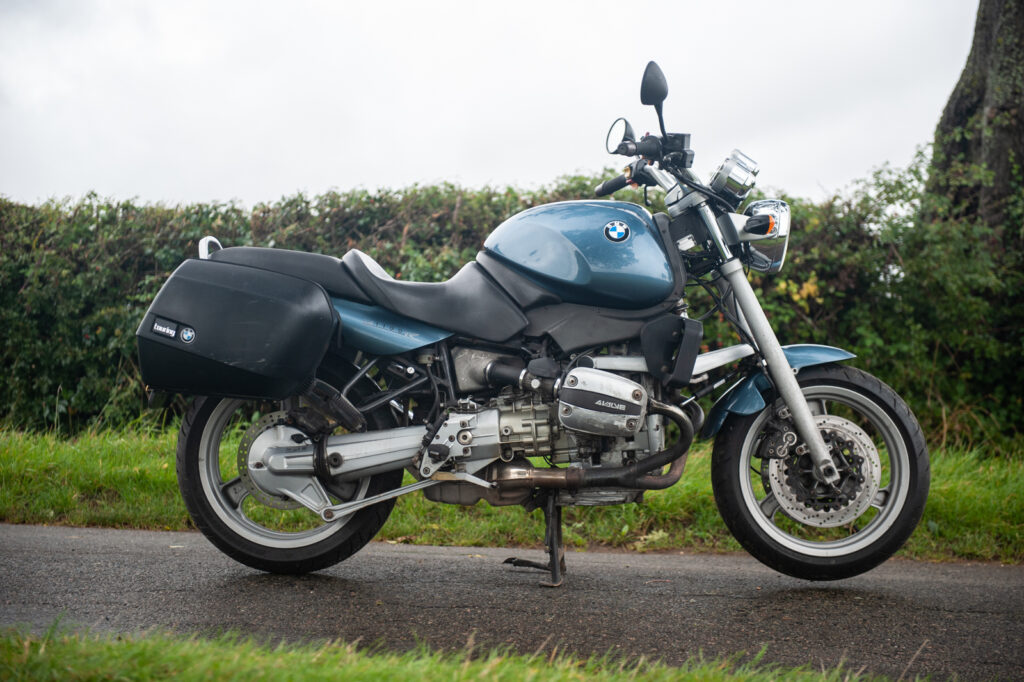
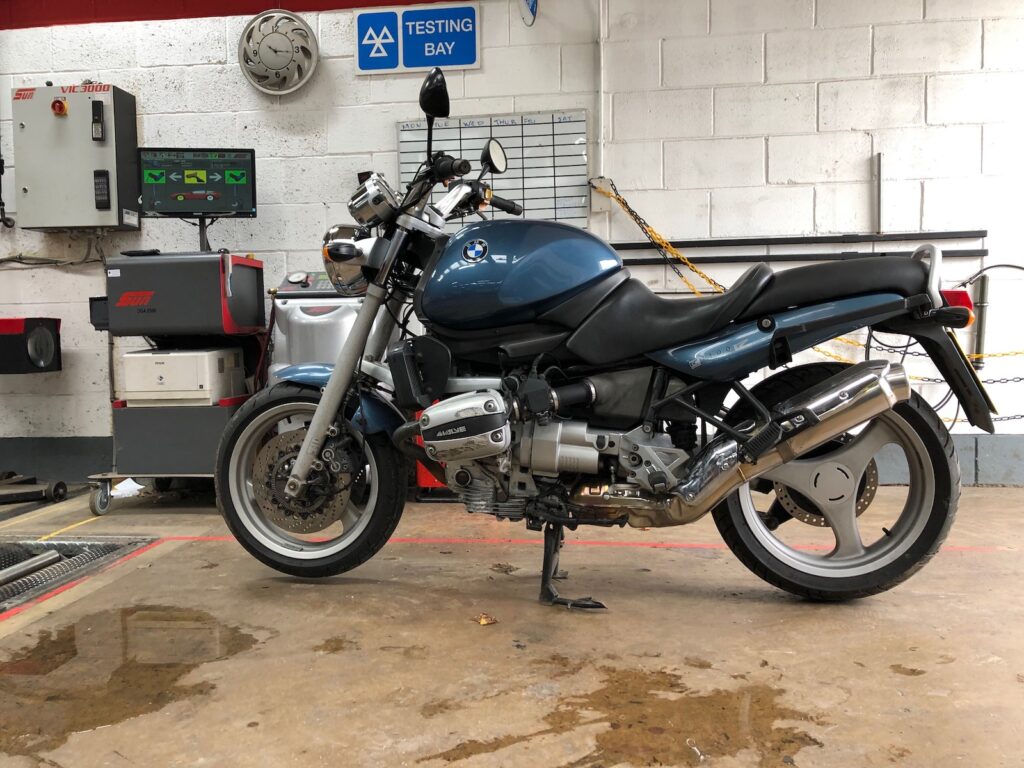
Although I love to sell and my career has taken me through selling all sorts of things, I don’t particularly like selling my own bikes. I buy old bikes to ride, repair and enjoy them, but occasionally one just ends up with too many motorcycles and a few have to be sold to make room for more. I sold one of my BMW R1100R models on eBay in the depths of winter last year. Here’s some information on that one.
First registered on June 6, 1997, the bike had good history. I had serviced it the previous year. At the time of selling, I owned seven other BMWs and all were underused: this one had covered just 220 miles since it was serviced and I would prefer it to be used and enjoyed, so I prepped it for an MOT with a new steering head bearing and all the usual checks and adjustments and it was sold ready to ride away with a year’s test.
I’d bought the bike from Geoff, a pastor down in Sussex. He had owned it for several years but was selling to pay for some work on the church and the adjoining family house. I spent an enjoyable morning with the family when I bought the bike and it had a great vibe about it. My use of this bike had centred on riding out with my daughter while she was riding a Piaggio 50 to college and back: a thirty-mile round trip. I had done quite a few miles with her over twelve months, building her road sense in the run up to doing he car driving test.
The torquey engine makes the R100R huge fun to ride. This bike was sold with the BMW touring luggage panniers not seen in these photos. All the cases, seat lock and ignition worked with one key (there were also two spares).
BMW R1100R Specification and Equipment
Finished in Dolphin Blue Metallic, the paintwork was all original and in decent condition. Non-servo ABS was fitted and worked fine. The bike also had factory-fitted two-stage heated grips, which work very effectively, complimenting the ABS to make these bikes an ideal winter ride to keep expensive summer bikes off the salty roads.
Older oilheads are a great introduction to BMW flat twins for not a lot of money. R1100Rs ride very well. They are a beautiful fit for my size and shape: the seat height is highly adjustable, the brakes and suspension are excellent and that punchy, fuel-injected engine is a joy to use. I think these bikes are amongst the best blend of classic riding qualities with modern-day conveniences that the airhead models don’t have.
Service History
The bike benefitted from many new parts, including a new rear shock absorber at 42k miles and a new clutch at 52k miles. A replacement transmission from a low-mileage 1100R had been fitted and the gearchange was excellent. Both tyres were in as-new condition – Dunlop Supermaxx up front and Bridgestone BT023 in the rear – and the brake discs and pads front and rear were also nearly new.
The service book was stamped up to 35k miles, after which it was home serviced by keen owners, with receipts showing some help from experts on more involved jobs like the clutch fit and gearbox swap, changing the throttle cable (43k) and balancing the throttle bodies. As I enjoy working on my bikes, I carried out quite a bit of work including repairing the common ignition switch wiring faults and going through the loom to find any other issues, a full fuel tank rebuild including later fuel pump and new filter, new air filter, changing the dash bulbs and fitting new BMW hand grips.
Some signs of age were inevitable, including the usual BMW corrosion to powder-coated engine parts, which any oilhead owner will be familiar with. Irrespective of the cosmetics, the bike was a very usable vintage BMW in good mechanical order at a sensible price. It would make a fun commuter, great base for a classic scrambler or a just winter weekend fun bike to keep a newer machine safely tucked up indoors, away from the salty roads.
The bike sold online and was collected by a friend of mine who delivered the bike to its new owner. eBay is a good place to sell bikes. This one went for £1700 and was just about the cheapest R1100R I have seen in recent months. I was happy to pass it on to a good new home.
Use my valuation services to protect your cherished assets
I added a 2005 Ducati Monster 800 S i.e. to the stable last week. I owned a very late carbed 750 Monster a few years back, which was a lovely bike to ride but it suffered from chronic carb icing, was a little low on straight line grunt and had also been used in London and stored on the street, so condition was not great.
I have ridden a few bigger Monsters – both air- and water-cooled – and came close to buying an S4 once upon a time, but really they are a bit too front heavy and the air-cooled bikes feel ‘more proper’. I think the 900 is a little heavy also, so the short lived injected 800 has a reputation as the sweet spot in terms of weight vs power amongst anoraks.
Anyway, about ten years ago, a seed was sown to find an 800. Like Ferraris, most Monsters are sold in resale red. The Metallic Blue bikes used in the press shots were made in very small numbers – just 5 of the 88 bikes that came to the UK were finished in blue. I love that look, so an 800 Monster in Blue has been on my list for a very long time.
Looking on and off for several years, I recently found one of the five: a two owner example with 12k miles, engine paint a bit scruffy as it lived on the street for a bit (like all old Monsters really) but wearing a pair of Remus cans and a Power Commander. Also had a pair of rare Monster panniers matched to the bike.
Negotiating and buying the bike was not straightforward. The price was a little high given the condition, plus it was up in the wilds of Scotland, so I set a max price and made the guy an offer. Patience paid off and a month later we agreed a deal. I paid a deposit and booked a courier to collect.
He got there at 8pm in the evening and then it turned out that the seller’s bank would not accept incoming transfers from any of my banks after 6:30 at night. It took some convincing but, after doing the transfers and sending him screenshots, the guy released the bike to the courier, his bank sorted the transfer issues the next day and all was good. The little blue Ducati arrived with me a week ago.
I’ve been tied up with valuation work on several court cases for weeks, so left the bike in the garage and set my first ride as a reward. I finally shipped my last report yesterday, so wheeled out the Ducati for a late evening ride. It did not disappoint! Beautiful pickup with the Power Commander watching over things and such a sweet power to weight ratio.
I’ve bought some adjustable Showas for the front and the cosmetic bits can wait until winter. My mission for the rest of the summer is to wear out the old tyres and just enjoy being back on a Monster. Good times 👍🏻
Use my valuation services to protect your cherished assets
As a long-time motorcyclist and classic bike enthusiast, I love all classic bikes, but if I had to pick one to look at for the rest of my life, it would probably be the Ducati Paul Smart 1000 LE.
This beautiful bike was unveiled to commemorate Smart’s famous victory in the 1972 Imola 200 event, riding a 750 Desmo that would go on to become the 750SS. Before the event, Smart admitted to being dismissive of Ducati, regarding the brand as a manufacturer of out of date single-cylinder machines. All that would change.
At the time of the Imola 200, he was racing in the US but not earning enough to live on. When his wife called and said Ducati wanted him to ride for the factory in the Imola 200, it was a no brainer to jump on a plane to Italy. The story of the weekend is excellent and well worth reading: Smart eventually won the race and got to keep his bike. The victory was a key moment in Ducati’s transformation into a high performance brand for the modern era and kicked off a long association between Smart and Ducati.
About the Ducati Paul Smart 1000 LE
First offered to the market in 2005, the Paul Smart LE was based on Ducati’s trusty air-cooled 1000DS twin. Designed by the famous Pierre Terblanche, the bikes were incredibly stylish and completely unique. However, the styling was not for everyone and the bikes lasted for just a few years until production ceased in 2010.
Just 2000 Paul Smart Ducatis were built and they are now highly desirable. My friend Chris had one, which I coveted deeply. He rode all over Europe and back to Ducati factory. He describes it as a physically painful but emotionally rewarding experience! Good examples currently fetch up to twenty thousand pounds and have therefore sailed beyond my financial reach, but if prices ever begin to fall again, I will have to find a way to get one.
Bonhams offered this 2006 Ducati Paul Smart 1000 LE at its Las Vegas sale in January 2020. Frame no. ZDM1WABP16B001646 was offered in its original crate as an unused and highly desirable Limited Edition model. The wide estimate of £19-25,000 suggests some uncertainty on behalf of the vendors but no doubt this was always going to sell for over £20k. In the end, the unused Paul Smart sold for £21,256 including the buyer’s premium, closer to the low estimate than the high.
The value of this bike could be said to be in its unused condition, but if we think of it as buying a highly desirable brand-new Ducati Limited Edition ready to be used and enjoyed for just £21,000, that is a very good buy. Whether one uses it or keeps it in the crate, it will remain a joy to behold. I think I would use it and keep it in the living room.
Use my valuation services to protect your cherished assets
I gave some pre-sale valuation feedback on an interesting bike over the weekend: a 1939 Ariel VH500 Red Hunter. Raced with some success in the 1950s/60s, the bike had been modified to make it lighter using well manufactured alloy parts and the engine had also been modified to lift compression and deliver a bit more power. The bike was presented in very good order: unrestored with wonderful patina.
About Ariel Motorcycles
Ariel is an interesting manufacturer from a valuation point of view. Founded in 1870, the company grew from cycle manufacturing to unveiling its first motorised cycles in 1902 and went on to produce some very innovative motorbikes. The Ariel design team included two legends of British motorcycle history: Edward Turner and Valentine Page. Both progressed to greater things and their work for Ariel has gone down in history.
Ariel was run by Jack Sangster and his success with Turner’s 1930 Ariel Square Four and the later VH500 Red Hunter allowed him to buy the Triumph motorcycle company in 1936. He later sold both companies to BSA (the Birmingham Small Arms company) and took a seat on the BSA board. He eventually took over full chairmanship of the BSA group.
While BSA continued to manufacture Ariel motorcycles through the 1950s and 60s, the bikes were fairly drab in comparison to the pre-war machines. Most of the Red Hunters seen for sale nowadays are 1950s BSA examples and, while they do command a reasonable value, they are nothing like as stylish as the pre-war Ariels.
A 1939 VH500 Ariel Red Hunter is pretty unique: most would have been manufactured shortly before war broke out. We can safely say that production in 1939 was low, so this is a rare survivor. It is difficult to find many examples of 1939 VH500s online – let alone bikes that are actually for sale or have sold.
Ariel motorcycle valuation and investment
Pre-war bikes are sought after by collectors. A VH500 with well documented and pretty successful historic race history is a rare thing and that counts for a great deal when it comes to desirability. TT bikes of this era are extremely desirable and that classic bike cachet of ‘a dangerous time but living for the moment’ will certainly have an impact on the value of other race machines from the period. The Ariel brand also enjoys a vibrant following, supported by Draganfly and the Ariel Club Slovakia and cult followings like this can often throw up quite a lot of interest.
Looking at sales, there is some evidence to suggest that the brand is currently undervalued versus other pre-war manufacturers. Auction prices for an apparently original and complete light restoration base starting circa £5k in Sept 2015 up to £9k for a very nice example located in France a few years later. Not huge numbers for pre-war runners.
Old race stories and unfakeable patina often appeals to collectors, so I stuck my neck out a bit and put my low estimate circa £9k. The history and archive appeal to me says it might top out well ahead of that but that is a little bit of guesssswork bassed on previous sales and we don’t know how coronavirus will put people off paying record prices for an uncertain investment opportunity. A lot of these bikes change hands behind closed doors and true data is hard to come by.
If I was sending this bike to auction with fully documented race history and period photos etc, I would be keeping my fingers crossed for a winning bid somewhere around £10.5 – 12k. It is important to play up the history to bring out the serious race bike collectors and people who see Ariel as one of the opportunities for long term investment. I am probably in that group somewhere.
Library photo from Wikipedia shared under CC licence
Use my valuation services to protect your cherished assets
This morning’s workload included an insurance valuation for a rare 1982 Yamaha XJ650RJ – a 650 Seca. Made for one year only, the 650 Seca is a good example of the sort of bike that many former classic car collectors who have recently come to the two-wheeled arena are looking for.
The 650 is in top condition. The model was built in comparatively low volume and enjoys what might be termed a cult following: “if you know, you know”. Unrestored examples are thin on the ground – this one was imported from America – and bikes still in their original paint are few and far between.
Classic Bike Values: Patina versus Restoration
Collectables are only original once: restoration destroys the patina of age. Patina cannot be recreated and it is really where the true value of antiques and collectables lies. Patina usually comes at the cost of condition, except where an item has been used sparingly and lovingly cared for by previous owners, resulting in the gentle patina of true appreciation. The rarified glow of almost-new condition is why low mileage, low owner cars and bikes achieve the highest selling prices.
This particular 1982 Yamaha XJ 650 RJ Seca was a fine example of a very rare motorcycle. Presented in immaculate condition with very low mileage for the year of 27,262 miles warranted by a full service history, the majority of the paint is original. While the XJ 650 RJ was originally sold only in Europe, America is the best place to buy these machines as the specification is close to our own and the dry climate has kept them in good condition.
The XJ 650 is one of those classics which has aged well. Enthusiasts appreciate the four-cylinder air-cooled engine (rather than the more common twin cylinder used on the XS650), the comfortable riding position and the evergreen classic styling. When presented in spotless condition, it is easy to see why they are desirable and tend to stay in collections for a very long time.
As surviving examples remain tied up in collections, market activity is low and data is hard to come by. Yamaha XJ650 Seca Turbo models do come up for sale, but they tend to carry optimistic dealer prices. That said, their sales at auction are indicative of general trends for bikes of this era.
Considering the rising market for affordable, rideable classics of this era, the huge interest in classic Japanese machines in original, unrestored condition, the low supply of bikes of this calibre and specification and the superb condition of this bike and the difficulty one would have in replacing it like for like, recent market data suggests that insurance valuations for bikes like this are certainly around the £3k mark, and perhaps 50% or more on top for seriously low mileage machines.
This website uses cookies to improve your experience. We'll assume you're ok with this, but you can opt-out if you wish. Cookie settingsACCEPT
Privacy & Cookies Policy
Privacy Overview
This website uses cookies to improve your experience while you navigate through the website. Out of these cookies, the cookies that are categorized as necessary are stored on your browser as they are as essential for the working of basic functionalities of the website. We also use third-party cookies that help us analyze and understand how you use this website. These cookies will be stored in your browser only with your consent. You also have the option to opt-out of these cookies. But opting out of some of these cookies may have an effect on your browsing experience.
Necessary cookies are absolutely essential for the website to function properly. This category only includes cookies that ensures basic functionalities and security features of the website. These cookies do not store any personal information.
Any cookies that may not be particularly necessary for the website to function and is used specifically to collect user personal data via analytics, ads, other embedded contents are termed as non-necessary cookies. It is mandatory to procure user consent prior to running these cookies on your website.